
Summer, vanlife, adventure — and somewhere on the back seat your dog lies looking at you with that look. You know the one. The “When will this stop?” look. Heat isn’t a comfort issue for dogs — it’s a real danger. And if you live or travel with your dog in a van, you need a serious answer to the question: How do I cool the van so my dog is safe?
In this article, you’ll learn which cooling systems actually work for vans, what they cost, how much power they need — and where even the best technology hits its limits.
1. The Temperature Problem: Numbers You Need to Know
Let’s start with the hard facts, because they matter.
A car heats up faster than most people think. At 68°F (20°C) outside, a parked vehicle’s interior can reach 115°F (46°C) within an hour. At 86°F (30°C) outside, it’s already over 122°F (50°C) after 20 minutes. Even a slightly open window barely makes a difference.
Dogs regulate their body temperature differently than humans. They don’t sweat through their skin but cool themselves almost exclusively through panting. This system is efficient — but not unlimited. Above a body temperature of around 104°F (40°C), hyperthermia (overheating) sets in. At 106-108°F (41-42°C), organ failure threatens. The process is fast.
Especially at risk are:
- Brachycephalic breeds (Bulldog, Pug, French Bulldog, Boxer) — their shortened snout anatomy significantly restricts airflow and thus panting’s cooling capacity
- Senior dogs and puppies
- Overweight dogs
- Dogs with heart problems or respiratory conditions
- Dogs with dark, dense coats
What does this mean for the van? A van standing in the sun is no longer a vehicle — it’s an oven. Even a well-insulated build only gives you a few more minutes. Without active cooling, a dog in a stationary van is in mortal danger within a short time at summer temperatures.
2. AC System Types Overview
There isn’t one solution. What fits you and your dog depends on van type, budget, and travel style.
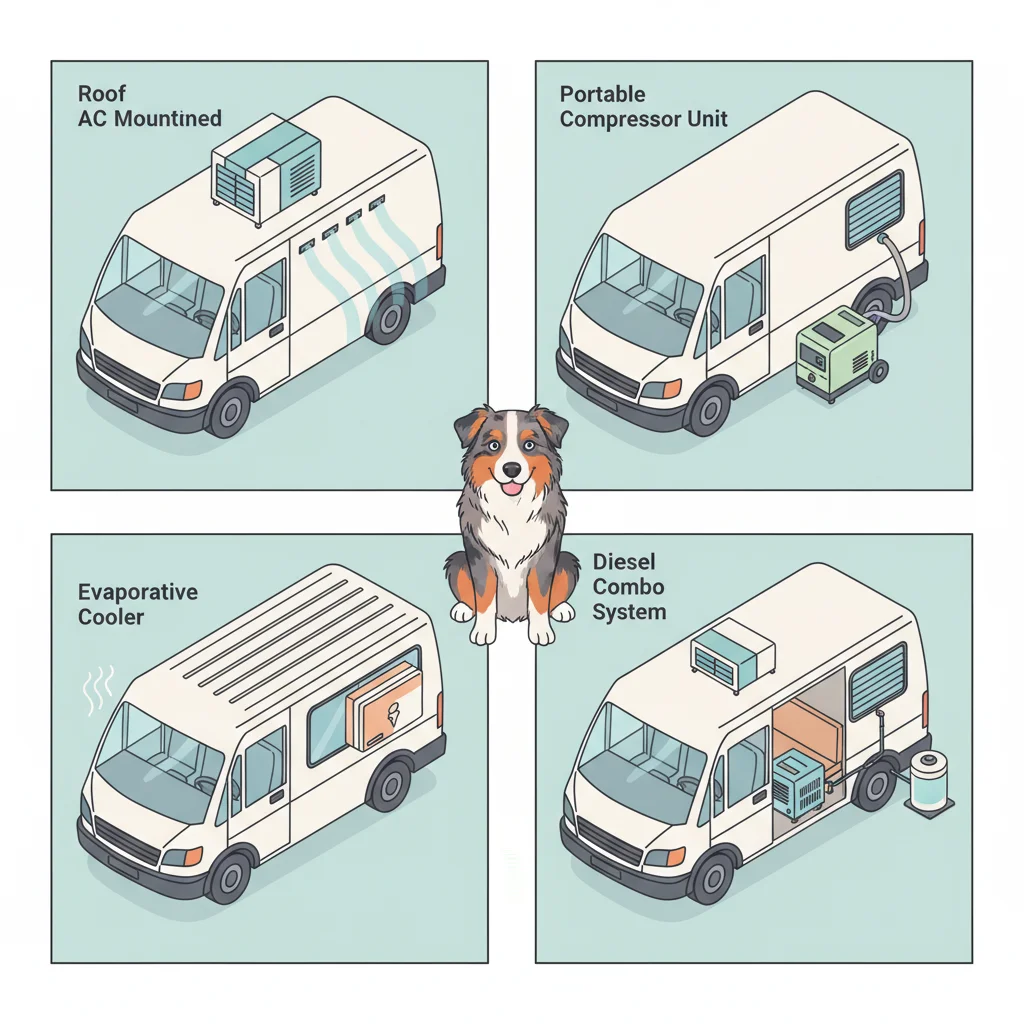
Rooftop AC (Stationary Air Conditioner)
The most professional solution for vanlifers. Models from Dometic (RTX 1000, Freshwell 1600) or Truma (Aventa Comfort) are permanently mounted on the roof and cool the van with 1,000-2,000 watts of cooling power.
| Cooling capacity | 1,000-2,500 Wh (depending on model) |
| Power consumption | 400-600 W |
| Purchase cost | $1,600-3,800 (including installation) |
| Noise level | moderate (~45-55 dB) |
| Suited for | Permanent vanlife setups, travel in hot climates |
Pros: High cooling capacity, can run on shore power, integrable into vehicle automation Cons: Expensive to buy and install, increased total power consumption, weight on the roof
12V Compressor AC (Portable)
Devices like the Zero Breeze Mark 2 or the EcoFlow Wave 2 are portable compressor air conditioners that run directly from a 12V battery or power station.
| Cooling capacity | 500-1,000 Wh |
| Power consumption | 180-450 W |
| Purchase cost | $750-1,700 |
| Noise level | 45-52 dB |
| Suited for | Flexible setups, short stops, smaller vans |
Pros: No installation needed, portable, combinable with power stations Cons: Lower cooling capacity than roof-mount, heat exhaust must be routed outside
Evaporative Cooler
Principle: water evaporates, air cools down. Cheap, quiet, but heavily weather-dependent.
| Cooling capacity | 4-14°F (2-8°C) reduction |
| Power consumption | 15-50 W |
| Purchase cost | $85-320 |
| Suited for | Dry heat (Southern Europe, desert), not for humidity |
Pros: Very energy-efficient, quiet, affordable Cons: Barely works in high humidity, doesn’t reliably cool to safe temperatures
Diesel Heater with Cooling Function
Devices like the Webasto BlueCool combine heating and cooling in one system. Cooling runs through a water-cooled circuit.
| Cooling capacity | 800-1,500 Wh |
| Power consumption | 80-200 W (cooling via compression refrigeration) |
| Purchase cost | $2,100-4,300 |
| Suited for | Year-round vanlifers who need a heater anyway |
Pros: One system for heating and cooling, relatively energy-efficient Cons: High purchase cost, complex installation
3. Power Supply: The Underestimated Question
The best AC is useless if the power runs out. This is the most common planning mistake in van builds.
Basic calculation: A rooftop AC consuming 500W runs for 2 hours on a 100Ah LiFePO4 battery (at 12V: 1,200 Wh). That’s enough for short breaks — not for an evening or a night.
What You Really Need
Battery capacity: For serious stationary cooling, at least 200 Ah LiFePO4 (Lithium Iron Phosphate) is recommended. These batteries are more expensive than AGM but allow deeper discharge (80-90% usable capacity vs. 50%) and last longer.
- 200 Ah LiFePO4 ~ 2,400 Wh usable
- AC at 500W - roughly 4-5 hours runtime
Solar: 400W of solar panels on the roof generate about 1,600-2,000 Wh per day in good sunlight. This can partially offset the AC during the day, but not fully.
Shore power: Those parked at campsites have a power outlet — that’s the most comfortable solution. A 230V shore power connection allows operation of all devices without battery drain.
Recommended setup for dog owners:
| Component | Recommendation | Cost |
|---|---|---|
| Battery | 200 Ah LiFePO4 (e.g. Renogy, LiTime) | $650-1,300 |
| Solar | 2x 200W panels | $320-540 |
| Charge controller | MPPT 40A | $100-210 |
| Shore power | CEE connection with feed-in | $160-320 |
4. Practical Tips Even Without AC
Not every build has room and budget for a stationary AC. These measures help reduce the van temperature:
Insulation Done Right
Good insulation protects not only from cold but also from heat. Armaflex or XPS panels in the floor, walls, and ceiling can significantly slow the van’s heating. Reflective exterior covers for the windshield and windows (Reflectix) help additionally.
Strategic Parking
- Always park in shade, preferably under trees
- Pay attention to the sun’s path: mornings the vehicle ideally faces east, afternoons the sun is in the west
- Use cross-ventilation: if possible, open windows and roof hatch to create airflow
- White or light vehicles heat up significantly slower than dark ones
Optimize Ventilation
A roof fan (e.g. Maxxair or Dometic Fan-Tastic) creates significantly more comfortable conditions through active air exchange than open windows alone. At 12-20W consumption, these fans run for hours on small batteries.
Cooling Aids for the Dog
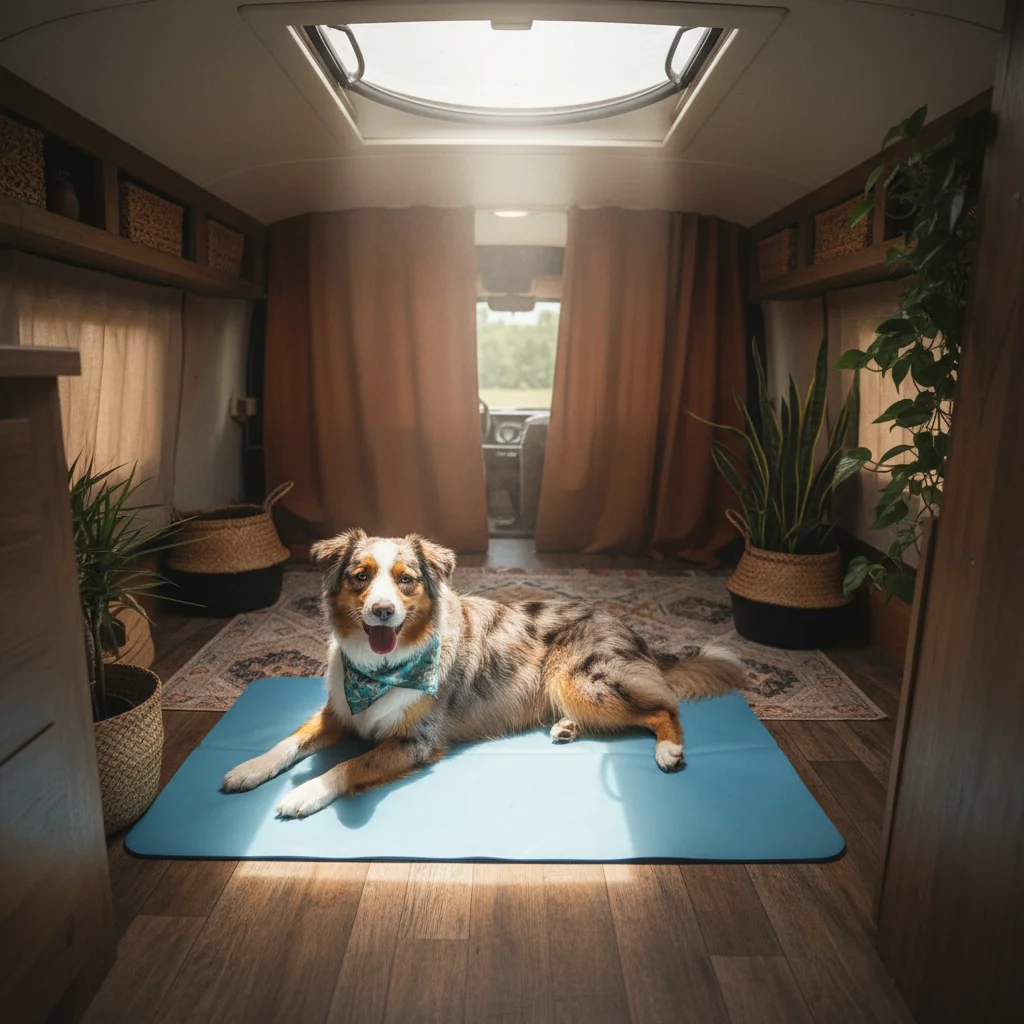
- Cooling mats (gel mats or water-cooled models): reduce body temperature directly
- Wet towels on paws and groin area: cool quickly and efficiently
- Fresh water accessible at all times — dehydration amplifies overheating
- Cool coat: water-soaked special vest that cools through evaporation
When You Shouldn’t Drive at All
Between 11 AM and 3 PM, solar radiation is at its highest. Use this time for breaks in cool, shaded locations — or drive early morning and evening.
5. The Honest Limit: When No Technology Helps
Here we must be honest.
Above about 95°F (35°C) outside — and in high summer in Southern Europe, those are perfectly ordinary conditions — even good cooling systems hit their limits. When the outside air is 99°F (37°C), a rooftop AC might cool the van to maybe 82-86°F (28-30°C). That’s better than 122°F (50°C) — but it’s not a comfortable climate for a dog locked inside alone.
The real problem isn’t just temperature, but unpredictability.
What if the power goes out? What if the device fails? What if you’re gone longer than planned? Dogs can’t open the door, can’t call for help, can’t escape the van.
That’s the moment where technology reaches its limits — and a safety net becomes important.
That’s exactly what notok.dog was built for. When you leave your dog briefly in the van, you can activate people nearby through notok.dog who can act in an emergency. Not as a replacement for good cooling — but as backup when the unexpected happens. Because even the best AC doesn’t protect your dog from a system failure you couldn’t predict.
Dogs die in cars. It happens to educated, caring dog owners. Usually because something didn’t go as planned.
6. Conclusion & Checklist
For dogs in vans, active cooling in summer isn’t a luxury — it’s a safety issue. Which solution fits you depends on your setup. But one thing you should never go without: a plan for when technology fails.

Your Summer Checklist for Dogs in Vans
Tech & Build
- Rooftop AC or 12V compressor cooler installed?
- Sufficient battery capacity for at least 4 hours of cooling?
- Roof fan for air circulation installed?
- Van well insulated (walls, floor, ceiling)?
- Sun protection for windows available?
Daily Routine
- Always park in shade?
- Cooling mat for the dog available?
- Fresh water accessible at all times?
- Schedule drives during cooler morning/evening hours?
- Never more than 20 minutes without AC above 77°F (25°C)?
Emergency Plan
- Someone knows where you are?
- Backup contacts for dog emergencies organized?
- Monitoring van temperature (e.g. via Bluetooth sensor)?
- notok.dog network activated for emergencies?
The combination of good technology, smart daily routines, and a reliable safety net is what truly makes vanlife with dogs safe. Your dog trusts you. That’s not a reason to relax — it’s a responsibility.
How quickly does a car really become a heat trap — and why don’t open windows help? Read our fact check: Heat Trap Car: How Quickly It Becomes Life-Threatening.