You know the warning. Everyone does. “Don’t leave your dog in a hot car.” Posters, social media posts, news reports — every year in summer.
But what about winter?
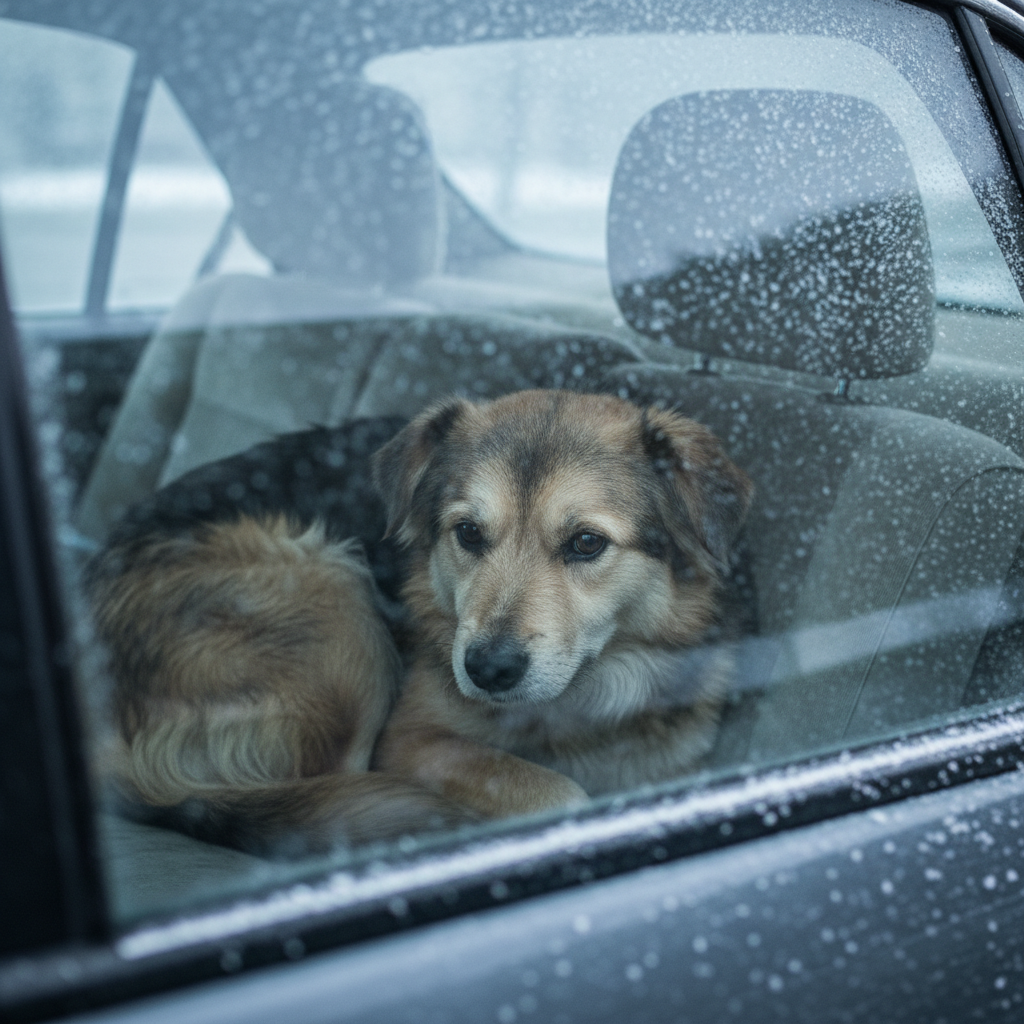
It’s December, minus 27°F (-3°C) outside, you just want to pop into the supermarket. 15 minutes, 20 max. Your dog is sleeping on the back seat, curled up, quiet. You think: It’s not hot. Nothing will happen.
And that’s exactly the mistake almost everyone makes.
A Car Is No Protection from Cold
In summer, a car is an oven. In winter, it’s an icebox. The physics are the same: a car has practically no insulation. The steel and glass body conducts temperature — in both directions.
How fast does a car cool down?
The heating is running, you get out, the engine turns off. From that moment, the car loses heat. Fast.
| Outside temperature | Interior after 30 min | Interior after 60 min |
|---|---|---|
| 41°F (+5°C) | ~50°F (10°C) | ~43°F (6°C) |
| 32°F (0°C) | ~41°F (5°C) | ~34°F (1°C) |
| 23°F (-5°C) | ~32°F (0°C) | ~25°F (-4°C) |
| 14°F (-10°C) | ~25°F (-4°C) | ~16°F (-9°C) |
Values based on measurements by automotive clubs and depend on vehicle size, wind, and sun exposure. Wind makes the car cool down even faster.
After an hour, the interior temperature is close to the outside temperature. And unlike a house, unlike a dog house — a car has no insulation, no heat source, no air circulation. Your dog sits in a metal box that’s as cold as the air outside. Just without wind. But also without freedom of movement.
Hypothermia: The Silent Danger
Everyone talks about heatstroke. Almost no one talks about hypothermia.
Yet the process is just as deadly. And just as quiet.
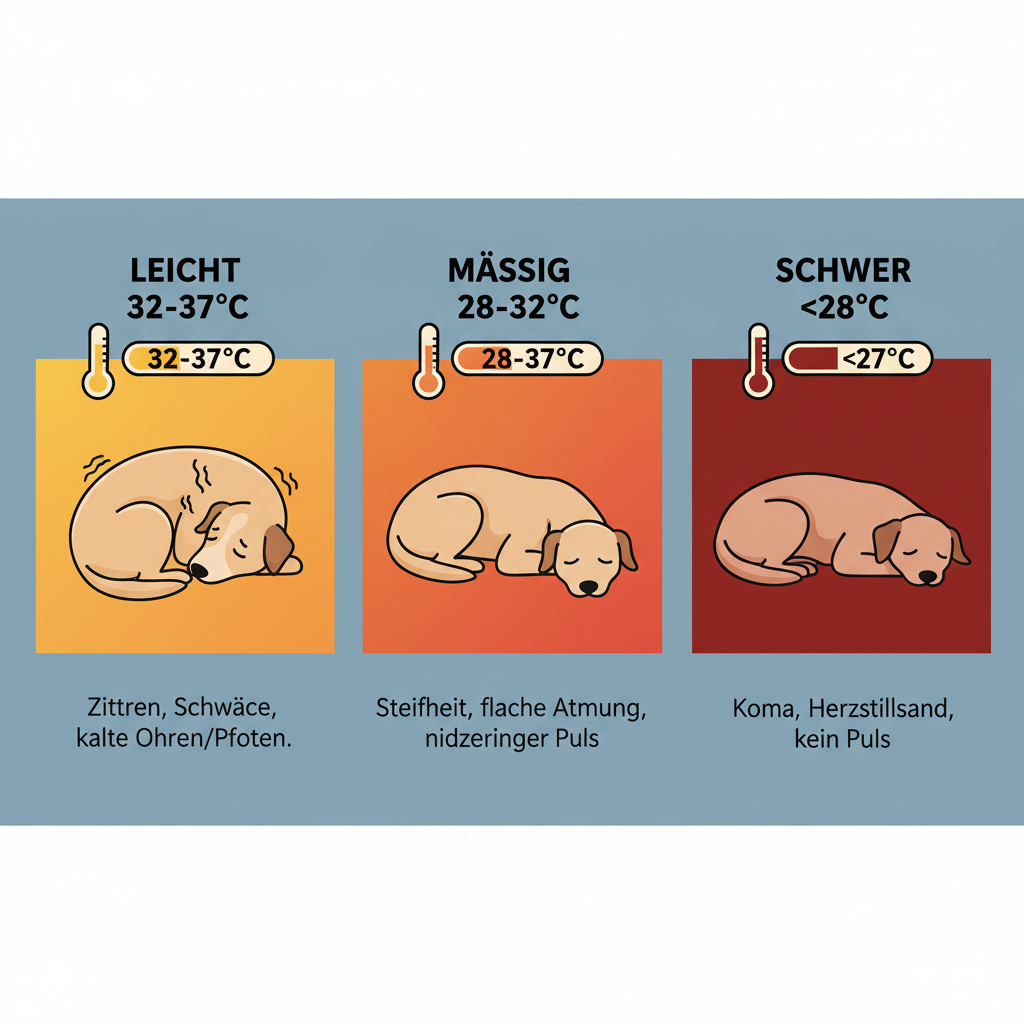
A dog’s normal body temperature is between 100.4 and 102.5°F (38.0-39.2°C). That’s slightly higher than in humans. And just like in humans, there are clear stages where it becomes dangerous:
Mild Hypothermia (90-99°F / 32-37°C body temperature)
Your dog shivers. They try to curl up, make themselves smaller. They become restless, change positions, look for warmth that isn’t there. Shivering is an alarm signal — the body tries to generate heat through muscle contractions.
At this stage, the situation is still reversible. But most dog owners aren’t there at this moment to see it.
Moderate Hypothermia (82-90°F / 28-32°C)
The shivering stops. That’s not a good sign — it means the body is giving up heat production. Your dog becomes stiff, muscles harden. Blood pressure drops. Breathing becomes shallow. They barely respond.
Severe Hypothermia (below 82°F / 28°C)
Fixed pupils. Barely measurable breathing. Heart rhythm disturbances. Organ failure. From this point, a dog survives only with immediate emergency veterinary treatment — and even then, not always.
Which Dogs Are Most at Risk?
Not every dog gets cold at the same rate. But every dog can freeze to death.
Small Dogs
The smaller the body, the larger the ratio of surface area to mass. This means: small dogs lose heat disproportionately fast. A Chihuahua, a Miniature Pinscher, a Yorkshire Terrier — they cool down in a cold car much faster than a Labrador.
Short-haired and Hairless Breeds
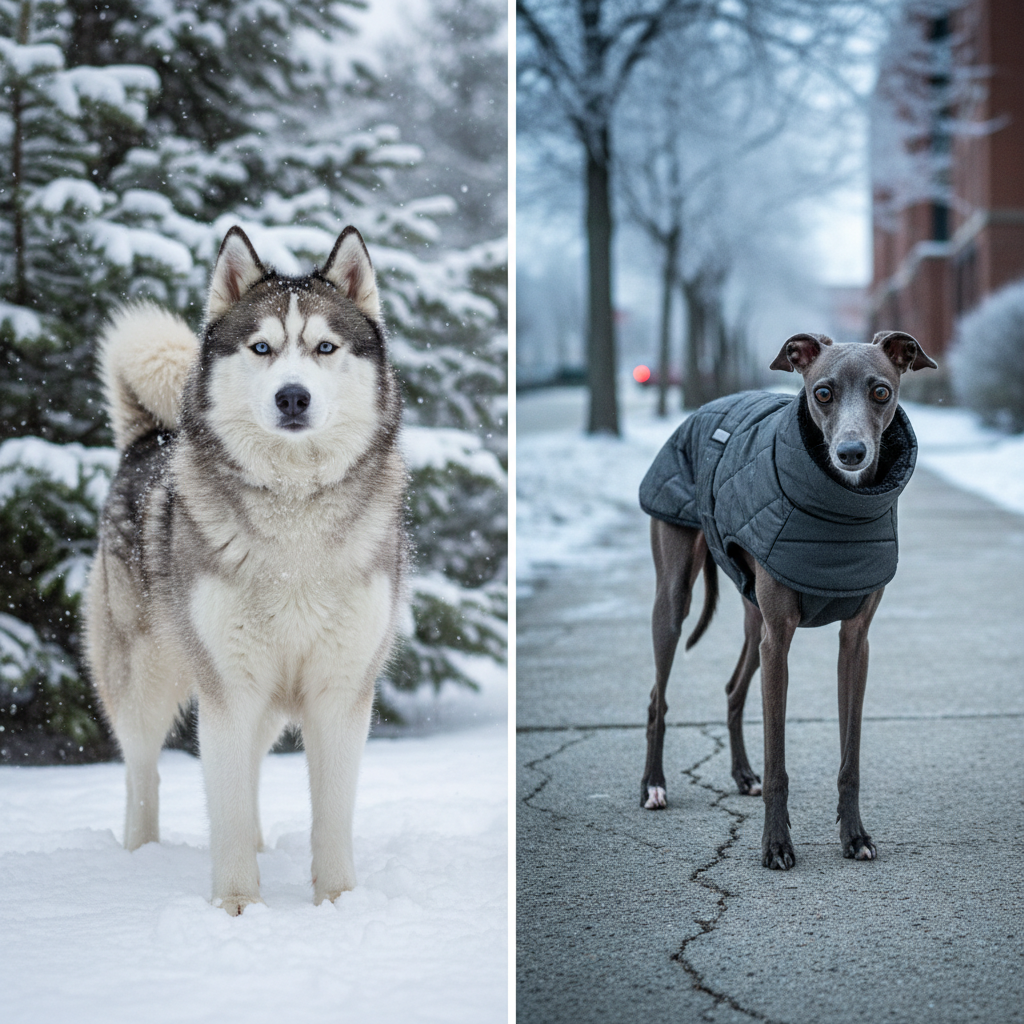
A Dalmatian, a Boxer, a Whippet, a Weimaraner — these dogs lack the insulating undercoat that protects Nordic breeds like Huskies or Samoyeds from cold. Their fur is thin, their skin nearly exposed.
And then there are breeds like the Chinese Crested or the Xoloitzcuintli — nearly hairless. For these dogs, even a walk in freezing temperatures without a coat is stressful.
Senior Dogs and Puppies
Older dogs have slower thermoregulation. Their metabolism works less efficiently, their muscle mass is often reduced — and muscles produce heat. Puppies, in turn, can barely regulate their body temperature in the first weeks of life.
Sick Dogs
Diabetes, hypothyroidism, Cushing’s disease, heart conditions — all these diseases impair the body’s ability to generate or retain heat. A dog with hypothyroidism gets cold at temperatures where a healthy dog would still be fine.
“But They Have Fur!”
That’s the sentence veterinarians hear most in winter.
Yes, fur insulates. But not all fur equally. And not enough.
A Siberian Husky with a dense double coat of undercoat and guard hair can withstand temperatures down to -22°F (-30°C) — outdoors, in motion, with the ability to seek shelter. In a parked car at 23°F (-5°C), motionless on the back seat, without movement, without escape, without a heat source? Even a Husky will eventually have problems.
And the vast majority of dogs aren’t Huskies.
Most household dogs — from the Labradoodle to the French Bulldog to the Jack Russell — have coats bred for life in heated homes. Not for hours of cold exposure in a metal box.
What the Law Says
Animal welfare laws are clear: anyone who keeps a pet must care for it appropriately and provide species-appropriate housing. A dog in a car at freezing temperatures is not “appropriately housed.” Period.
The legal situation is less clear-cut than with heat, where there are now precedent cases and clear recommendations from police and authorities. In winter, many agencies lack awareness. But that doesn’t change the responsibility.
Veterinary animal welfare associations recommend: dogs should not be left unattended in vehicles when temperatures fall below 41°F (5°C) — and for sensitive breeds, even earlier.
Practical Tips: Winter with Dog and Car
Sometimes it can’t be avoided. You need to go into the store, the dog can’t come along. Here’s what you can do:
Radically Limit Time
The most important rule: As short as possible. At temperatures around freezing, you have 15, maybe 20 minutes before it gets uncomfortable in the car. At sub-zero temperatures, less. Set a timer. No “just grabbing one more thing.” In, get it done, out.
Insulating Pad
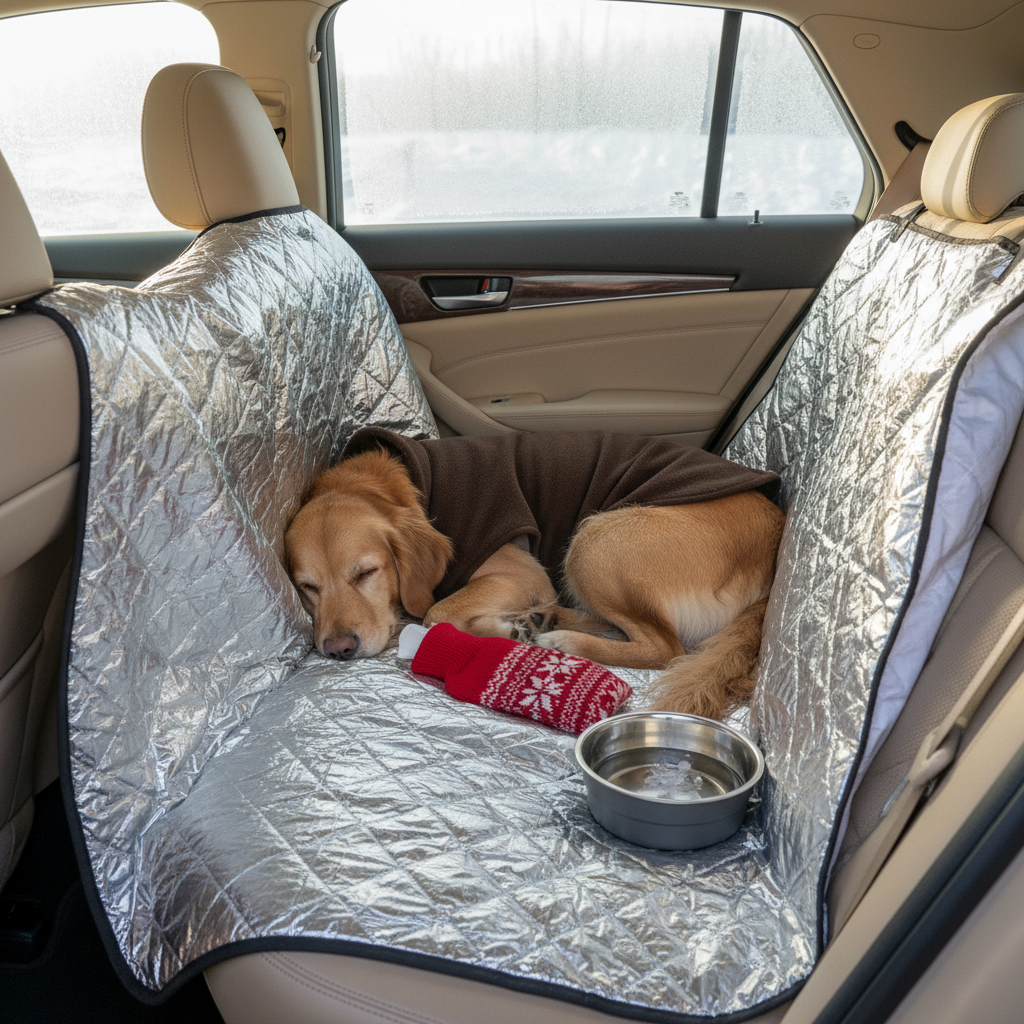
The floor and seats of a car are ice-cold in winter. A thermal mat or thick fleece blanket under the dog can significantly reduce heat loss downward. Contact with cold surfaces is one of the main ways a dog loses heat.
Dog Coat
Yes, even in the car. A well-fitting dog coat — especially for short-haired or small breeds — helps retain body heat. It doesn’t have to be fashionable. It has to be warm.
Engine & Heating
Some dog owners leave the engine running so the heating continues. This works — but it carries risks: exhaust fumes in enclosed spaces (parking garages!), fuel consumption, and the risk that the engine might shut off.
If you leave the engine running: Only outdoors, never in enclosed spaces. And even then: don’t rely on it. Engines can shut off, auxiliary heaters can fail.
Auxiliary Heater
An auxiliary heater (Webasto, Eberspacher) can keep the interior warm without the engine running. Many models can be controlled via app or timer. For dog owners who regularly travel in cold regions, it’s a worthwhile investment.
| Solution | Cost | Effectiveness |
|---|---|---|
| Thermal mat / fleece | $15-40 | Floor insulation, no active heating |
| Dog coat (insulated) | $30-80 | Retains body heat |
| Auxiliary heater (retrofit) | $800-1,500 | Active heating without engine |
| Bluetooth thermometer | $15-30 | Temperature monitoring via app |
The Honest Limit: When No Blanket Helps
Here too we must be honest. Just as no AC is 100% safe in summer, eventually no blanket, no coat, and no auxiliary heater helps in winter.
Because the problem isn’t just the cold.
The problem is that you’re not there.
What if the shopping takes 40 minutes? What if you’re held up? What if the heater fails? What if you end up in the emergency room and nobody knows your dog is in the car?
Dogs can’t open the door. They can’t call for help. They can’t make themselves noticed when the windows are frozen from the inside.
This is exactly what notok.dog is for. Not as a replacement for caution — but as a safety net when the unexpected happens. Through notok.dog, you can activate people nearby who can check on your dog in an emergency. No call center, no impersonal service — real people within reach who know your dog might need help.
Because most emergencies don’t happen because people are careless. They happen because something goes wrong that nobody foresaw.
Conclusion: Cold Deserves the Same Respect as Heat
We’ve learned that dogs don’t belong in cars in summer. That was a long, painful learning process — with too many dead dogs along the way.
With winter, we’re not there yet. Cold kills more quietly than heat. There are no overheated cars where passersby stop in shock. No dog panting desperately behind the windshield. A hypothermic dog goes quiet. They stop moving. They fall asleep.
And sometimes they don’t wake up.

Your Winter Checklist for Dogs in Cars
Preparation
- Thermal mat or thick blanket in the car?
- Dog coat for short-haired/small breeds available?
- Bluetooth thermometer installed in the car?
- Auxiliary heater available or retrofitted?
On the Road
- Never leave dog alone for more than 15 minutes below 41°F (5°C)?
- Set timer every time you leave the car?
- Engine/auxiliary heater only running outdoors?
- Water in the car that doesn’t freeze (insulated bowl)?
Emergency Plan
- Someone knows where you are and that your dog is in the car?
- notok.dog set up for emergencies?
- Nearest animal clinic with emergency service saved?
- Know the signs of hypothermia (shivering - stiffness - silence)?
Sources
- German Federal Chamber of Veterinarians — Guidelines for pet care at extreme temperatures
- Merck Veterinary Manual — Hypothermia in Dogs
- ADAC — Temperatures in parked cars — summer and winter
- Veterinary Association for Animal Welfare — Recommendations for dog care
- American Veterinary Medical Association — Cold Weather Safety for Pets
The combination of preparation, short time windows, and a safety net is what makes the difference. Cold is no less a risk than heat — it’s just a quieter one. Your dog trusts you. Even in winter.